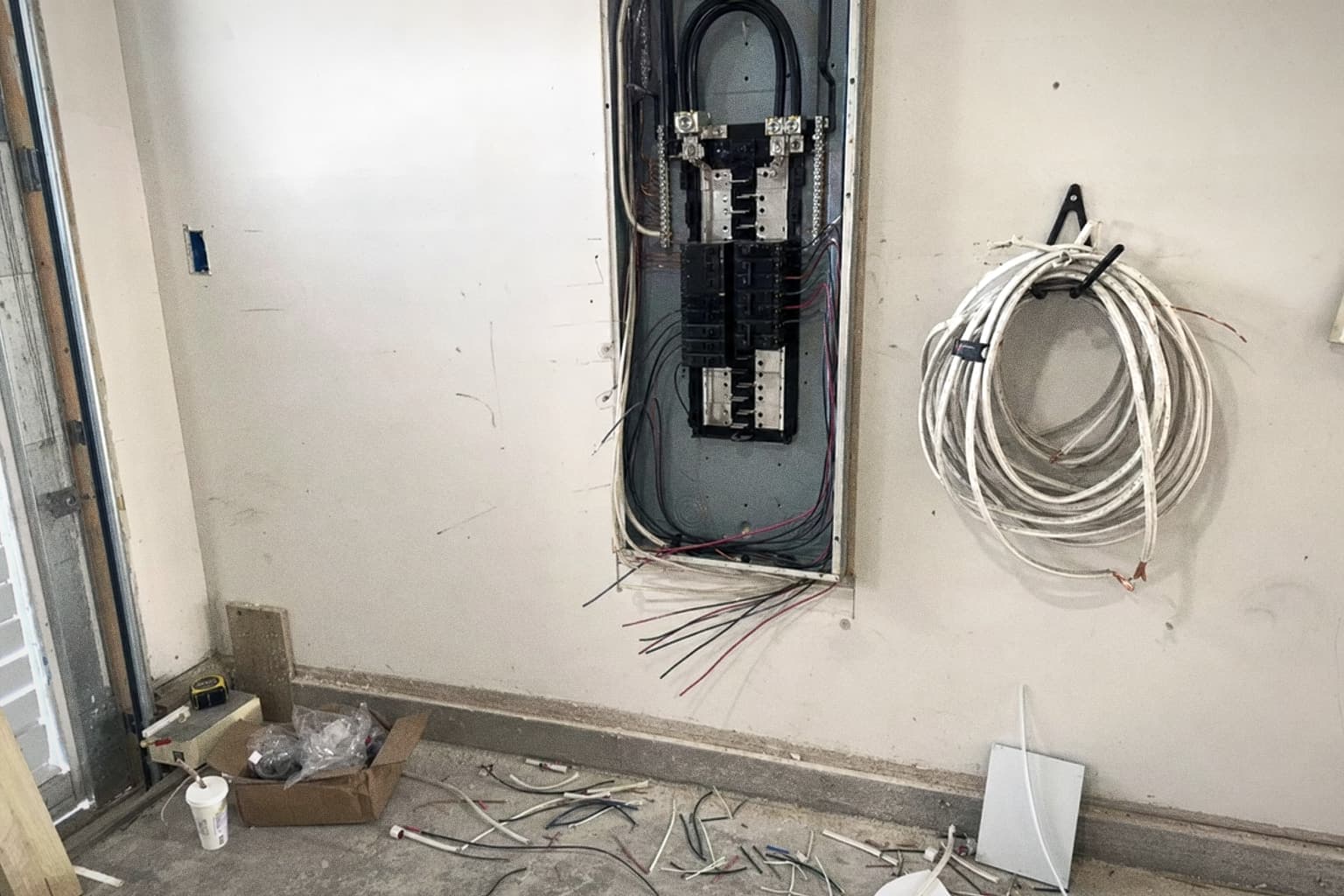
# 2023 NEC Changes for Florida: Service Entrance, Load Calculations & Voltage Drop
If you're prepping for your Florida electrical license exam, you already know that service entrance requirements, load calculations, and voltage drop are going to be tested. Hard. The 2023 NEC didn't completely overhaul these topics, but there are important clarifications and refinements that directly affect how we size equipment and run calculations. Let me walk you through what's changed, what matters most, and how to nail these sections when you sit for your exam.
Key facts
- NEC 230.71 limits the disconnecting means for a building to a maximum of six switches or circuit breakers.
- NEC 220.12 sets the general lighting load for a dwelling at 3 volt-amperes per square foot.
- NEC 220.52(a) requires a minimum of two small appliance circuits, each rated 20 amperes at 120 volts, with a demand load of 1,500 VA per circuit.
- NEC 220.55 and Table 220.55 apply an 80% demand factor to the nameplate rating of a 5-12 kW electric range.
- NEC 220.54 sets the electric dryer load at the nameplate rating or 5,000 VA minimum, whichever is larger.
- For a 200-amp service with 2/0 AWG copper service entrance conductors, NEC 250.66 requires a 4 AWG copper grounding electrode conductor.
Service Entrance Requirements Under 2023 NEC
The service entrance is where the utility's responsibility ends and yours begins. Getting this right isn't optional—it's the foundation of every job.
Main Service Disconnecting Means
Under NEC 230.70, you still need a readily accessible disconnecting means for the building. The 2023 code maintains that requirement, but let me clarify what "readily accessible" actually means: you can reach it without climbing or removing obstacles. It can't be in a locked cabinet unless it's a meter enclosure or similar. That's a common exam question.
NEC 230.71 limits you to a maximum of six switches or circuit breakers as the disconnecting means. This has been consistent for years, but test makers love asking "Can I use seven breakers?" The answer is always no.
Service Entrance Cable & Conduit Sizing
Here's where the 2023 NEC tightens things up slightly. NEC 230.42 governs service entrance conductor sizing, and it references Table 310.15(B)(2)(a) for ampacity. The key is that you must calculate your load first, then size your service entrance conductors to match.
For a 200-amp service with copper conductors, you'd use 2/0 AWG. For aluminum or copper-clad aluminum, 4/0 AWG. These are your bread-and-butter sizes in Florida residential work.
Conduit sizing? That's NEC 230.43, and you're using Table 4A in Chapter 9 for fill percentages. A 200-amp service typically runs 2-inch or 2.5-inch conduit depending on whether you've got two or three conductors plus ground.
Grounding Electrode Conductor Size — This One Changed
This is important. NEC 250.66 is where the 2023 NEC made a meaningful refinement for clarity.
Your grounding electrode conductor size is based on the largest service entrance conductor (or equivalent for parallel conductors). Here's the table you need to memorize:
- 2 AWG or smaller → 8 AWG copper or 6 AWG aluminum minimum
- 1 or 1/0 AWG → 6 AWG copper or 4 AWG aluminum
- 2/0 or 3/0 AWG → 4 AWG copper or 2 AWG aluminum
- Over 3/0 AWG (parallel) → 12.5% of largest conductor
---
Dwelling Unit Load Calculation: Article 220 Deep Dive
This is where we earn our paychecks. If you can't calculate a dwelling load, you can't size a service. Period.
General Lighting Load
Start here. NEC 220.12 gives you the baseline: 3 volt-amperes per square foot for general lighting in a dwelling.
For a 2,000 sq ft home:
- 2,000 sq ft × 3 VA/sq ft = 6,000 VA
Small Appliance Branch Circuit Load
NEC 220.52(a) requires a minimum of two small appliance circuits in the kitchen, dining room, breakfast room, pantry, and similar areas. Each circuit is rated 20 amperes at 120 volts.
Demand load: 1,500 VA per circuit. For the required two circuits:
- 2 circuits × 1,500 VA = 3,000 VA
Laundry Branch Circuit
NEC 220.52(b) requires one dedicated 20-amp circuit minimum for laundry receptacles. Load: 1,500 VA.
Kitchen Range, Oven, and Cooktop
This is where demand factors kick in, and this is always tested.
NEC 220.55 and Table 220.55 govern this. For a 5-12 kW range, apply a demand factor of 80% to the nameplate rating.
Example:
- 6 kW range × 80% demand = 4,800 VA or 4.8 kW
Electric Dryer
NEC 220.54 sets the load at the nameplate rating or 5,000 VA minimum, whichever is larger. A 4.5 kW dryer? You use 5,000 VA. A 6 kW dryer? Use 6,000 VA.
HVAC Load
NEC 220.60 is straightforward: use the nameplate rating of the air conditioning compressor or the heating element, whichever is larger. Don't add them together—use the larger of the two.
A 3-ton AC might be 10 kW. A 10 kW electric heater is 10 kW. You're calculating the service for whichever operates (not both simultaneously), so you use 10 kW as your load component.
Water Heater
Nameplate rating. Usually 4,500 VA to 5,500 VA for residential. Use what the nameplate says.
Demand Factor for Household Cooking Appliances
If your client has multiple cooking appliances (range plus wall oven plus cooktop—unusual but testable), Table 220.55 applies a demand factor. With two appliances, it's typically 75-80% of the sum. The code spells this out clearly.
Total Dwelling Load Calculation Example
Let's work through a real scenario:
2,000 sq ft, single-family residence with:
- Electric range (6 kW)
- Electric dryer (5.5 kW)
- 3-ton central AC (10 kW)
- Electric water heater (4.5 kW)
- 2,000 sq ft × 3 VA/sq ft = 6,000 VA
- 2 circuits × 1,500 VA = 3,000 VA
- 1 × 1,500 VA = 1,500 VA
- 10,000 VA (AC, larger than any heating)
- 6,000 VA × 80% = 4,800 VA
- 5,500 VA (nameplate used as minimum)
- 4,500 VA
- 6,000 + 3,000 + 1,500 + 10,000 + 4,800 + 5,500 + 4,500 = 35,300 VA
Wait—let me recalculate using the dwelling unit demand factor rules correctly.
For 220.82, after adding general lighting, small appliance, and laundry, you get 10,500 VA. Apply a demand factor of 100% to the first 10,000 VA, then 25% to the remainder.
- First 10,000 VA × 100% = 10,000 VA
- Remaining 500 VA × 25% = 125 VA
- Subtotal: 10,125 VA
- Subtotal: 10,125 VA
- HVAC: 10,000 VA
- Range (80% of 6 kW): 4,800 VA
- Dryer: 5,500 VA
- Water heater: 4,500 VA
This home needs a 150-amp or 200-amp service. Exam question: "Is 150 amps enough?" Answer: probably, but 200 is safer and standard in Florida.
---
Voltage Drop: The Formula You Must Know
Voltage drop kills you on exams because it seems simple but people mess up the formula constantly.
NEC 210.19(A)(1) and 215.2(A)(1) require you to account for voltage drop. The code recommends:
- 3% for branch circuits
- 5% for feeder circuits
- 8% maximum combined (but this is a recommendation, not a hard rule for sizing)
The Voltage Drop Formula
Here's the formula, and memorize this:
VD = (2 × L × I × R) ÷ 1000
Where:
- VD = voltage drop in volts
- L = length of conductor run (one way, in feet)
- I = current in amperes
- R = resistance per 1000 feet (from NEC Chapter 9, Table 8 or 9)
Practical Example
A 120-volt, 20-amp branch circuit runs 150 feet to a light fixture using 12 AWG copper (which has 1.98 ohms per 1000 feet per Table 8).
VD = (2 × 150 × 20 × 1.98) ÷ 1000 VD = (11,880) ÷ 1000 VD = 11.88 volts
This is ~10% voltage drop, which exceeds the 3% recommendation for a branch circuit. You'd need to upsize to 10 AWG to bring it in compliance.
10 AWG = 1.24 ohms per 1000 feet: VD = (2 × 150 × 20 × 1.24) ÷ 1000 = 7.44 volts (~6% drop)
Still high. 8 AWG = 0.77 ohms: VD = (2 × 150 × 20 × 0.77) ÷ 1000 = 4.62 volts (~3.8% drop)
Now it's acceptable.
Why This Matters on Your Exam
Exam makers love asking: "What wire size do you need for a 30-amp circuit running 200 feet at 240V to stay under 5% voltage drop?"
You must know how to work backward from the voltage drop limit to find conductor size. This is intermediate-level thinking that separates passing from scoring high.
---
Key Takeaways for Your Florida Exam
- Service entrance sizing starts with load calculation, then you size conductors using Table 310.15(B)(2)(a) and grounding electrode conductors using 250.66.
- Dwelling load calculations follow Article 220 with specific demand factors for appliances. Memorize the small appliance load (1,500 VA per circuit), range demand (80% for 5-12 kW), and the demand factor table for fixed appliances.
- Voltage drop uses the formula VD = (2 × L × I × R) ÷ 1000 and must stay under 3% for branch circuits, 5% for feeders. You'll need to work backward to find wire size from a voltage drop limit.
- Grounding electrode conductors are sized from the largest service entrance conductor—this changed slightly in 2023 for clarity, so review 250.66 before your exam.
- NEC Chapter 9, Tables 8 and 9 are your reference for conductor resistance. You don't memorize these; you use them. But know where they are and how to read them quickly.
Next Steps
Practice load calculation problems until you can do them in your sleep. Voltage drop problems are on nearly every exam—don't skip them. And when you're reviewing service entrance work, always cross-check your grounding electrode conductor size against NEC 250.66.
You've got this. Let me know what questions come up.
Common questions
How many disconnecting means switches or breakers can I use for a service?
NEC 230.71 limits the disconnecting means to a maximum of six switches or circuit breakers. This has been consistent for years and remains unchanged in the 2023 NEC. Test makers commonly ask whether seven breakers are allowed, and the answer is always no.
What is the general lighting load calculation for a dwelling under the 2023 NEC?
NEC 220.12 sets the baseline general lighting load at 3 volt-amperes per square foot for a dwelling. For a 2,000 sq ft home, that works out to 2,000 sq ft × 3 VA/sq ft, or 6,000 VA. This figure is the starting point before adding small appliance, laundry, and other loads.
How many small appliance circuits does a kitchen need?
NEC 220.52(a) requires a minimum of two small appliance circuits in the kitchen, dining room, breakfast room, pantry, and similar areas. Each circuit is rated 20 amperes at 120 volts, with a demand load of 1,500 VA per circuit. For the required two circuits, that totals 2 × 1,500 VA, or 3,000 VA.
What size grounding electrode conductor do I need for a 200-amp service?
Under NEC 250.66, the grounding electrode conductor size is based on the largest service entrance conductor. For a standard 200-amp residential service using 2/0 AWG copper service entrance conductors, that means pulling 4 AWG copper to the grounding electrode. NEC 250.66 is where the 2023 NEC made a refinement for clarity on this sizing.
What formula do I use to calculate voltage drop, and what are the limits?
The voltage drop formula is VD = (2 × L × I × R) ÷ 1000, where L is the one-way conductor length in feet, I is the current in amperes, and R is the resistance per 1000 feet from NEC Chapter 9, Table 8 or 9. NEC 210.19(A)(1) and 215.2(A)(1) require accounting for voltage drop, with the code recommending 3% for branch circuits, 5% for feeder circuits, and 8% maximum combined. In a worked example, a 120-volt, 20-amp circuit running 150 feet with 12 AWG copper produced 11.88 volts of drop, about 10%, requiring an upsize to 8 AWG to bring the drop to about 3.8%.